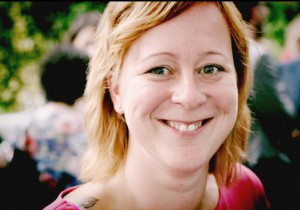
Caryn 't Hart de Wijkerslooth Profile

Every year, TEDxDelft features an impressive line-up of speakers and their ideas worth spreading. As one of the curators on the team, Caryn ’t Hart de Wijkerslooth is always eager to make each TEDxDelft event extra special in regard to the program’s content. “What I find very rewarding is trusting my eye for a good story,” she says. Indeed, finding good storytellers does not pose much of a challenge to ‘t Hart de Wijkerslooth, since she tries to instill this type of skill to her students at TU Delft. “’I teach public speaking, scientific writing and debating skills,” she shares. “Basically, I help future engineers tell their story in the best possible way.”

According to ‘t Hart de Wijkerslooth, there is a lot that visitors can look forward at this year’s event. “There will be lots of diversity, in a lot of ways,” she explains, “diversity in stories, people, ages, subjects.” That being said, ‘t Hart de Wijkerslooth is optimistic that the combination of speakers and their stories will lead to a program that visitors will truly appreciate. “I hope to see people enjoying the program that we arranged for the event,” she says.

It goes without saying that ‘t Hart de Wijkerslooths’ enthusiasm for TEDxDelft is clear for all to see. As a matter of fact, she is also helping to organize the first TEDxDelftwomen event, which will take place on May 29, 2015. With such a commitment to TEDxDelft, there is every reason to believe this year’s event will be a great success.

What is your role at TEDxDelft?

I’m one of the three curators. The word curator comes from the Latin curare, meaning “take care”. So, we take care of the program, basically. I look for possible speakers and performers to be on the TEDxDelft stage. I search , interview, and invite speakers and performers for the lineup, keeping in mind the balance in the program. Together with Rob Speekenbrink and Jeroen van Erp I will hopefully construct and design a wonderful program with good speakers for the next TEDxDelft.

Why did you get involved with the organization?

Because I am a story geek. I love reading stories, hearing stories, writing stories, referring to stories, discovering stories and helping people build up their story. In short, stories make me tick. I’m convinced that people are shaped by stories and at the same time,  shape stories. Stories might be the most important things we have. So, when I discovered TED years ago I immediately thought that it was so awesome. Then I discovered that there were TEDx events in the Netherlands as well. I knew I wanted to contribute straightaway.

How long have you been a part of the TEDxDelft team?

Since January 2013.

If you could choose one person to give a talk at TEDxDelft, who would it be and why?

Annie MG Schmidt. Definitely. It would be awesome to hear her speak about her power to be an original, how to find your spark.

What’s your nerdy little secret?

Although I stick to my vegetarian –mostly even vegan- diet, I love a klup burger from time to time at Café van Engelen in Leiden.
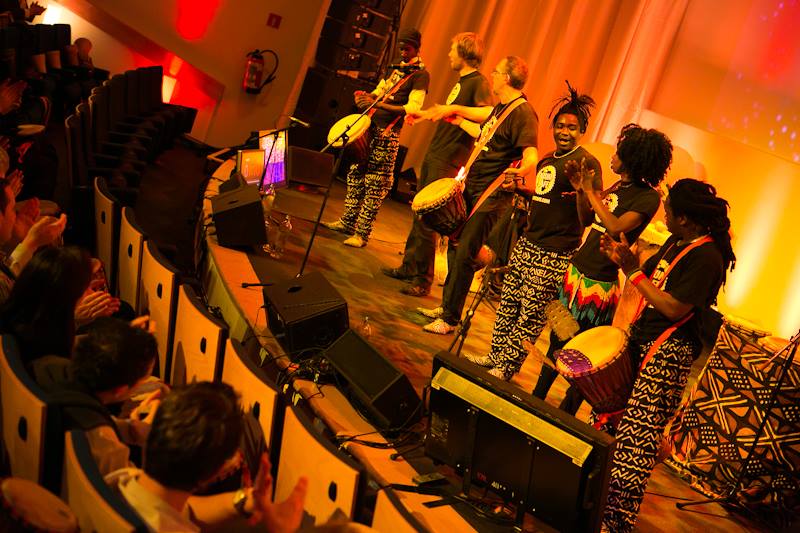
Drum Cafe
 

“To give every participant a new form of energy” is Patrick Tromp’s exuberant response, when asked what motivates Drum Cafe. Founded in Johannesburg in 1996 by Warren Lieberman, Drum Cafe is one of the world’s leading interactive team building, conferencing and corporate events companies. Building teams, one beat at a time – this is what the group aims to achieve during their performance at the upcoming TEDxDelft event.

For hundreds of years, be it in any culture, drumming has proven to be the most effective team building activity. That being said, Drum Cafe is known for incorporating music and rhythm to motivate, inspire and connect people. During every performance, audience members are each given a drum and are made to bring their unique sound into the mix, creating a one-of-a-kind percussion orchestra. The audience’s individuality and coordination builds team spirit, motivates team members and brings about a better understanding within the group.

“The humor in our concept and the energy we create through it are our most striking features,” says Tromp, head of Drum Cafe Benelux and facilitator for Drum Cafe Europe. The group’s unique method is a proven success in more than 50 countries, having presented in over 30,000 events. They help revitalize and refocus participants between presentations and enhance their receptive capacities.

According to Tromp, drumming is an effective ice-breaker, promoting unity with a sense of belonging. In fact, making music as a group sparks creativity, imparts learning and provides insights as to how important it is to collaborate and listen to one another. People’s true personalities come out instead of their corporate image. On a lighter note, drumming is infectious and hence, impossible to stay away from.

“The best audience one can get would be that which focuses and laughs a lot,” Tromp explains. “We understand how to energize a group of people and know how to connect individuals with each other.” Shedding light on how their approach has changed over the years with the varying expectations of the audience, Tromp says, “People are still people, they react the same to the energy we deliver. The only thing is that, with every session, we are getting better!”

Stop thinking and start feeling the rhythm as the drums are all set roll at the upcoming TEDxDelft event on February 27, 2015.

Inspiration can be found in the most unlikely places. While most chefs turn to seasonal or unusual ingredients to devise a delectable dish, culinary creative Yuri Verbeek looks to his surroundings and everyday experiences to create extraordinary cuisine. As head chef and owner of Delft culinary studio De Kokkerie, Verbeek believes that simple things can lead to surprising dishes.

“I create dishes in a special way,” says the award-winning chef. “I look further than the dish to try to surprise people.” Whether it is an ingredient, utensil or personal encounter, there are no holds barred for Verbeek when it comes to finding inspiration. “When I create something, I walk by IKEA. I walk by garden centers and see what they have there. And I like to play with those kind of materials with my dishes.”

On one occasion, the chef stumbled upon a perfume bottle while browsing at IKEA and had the idea to fill it with lemon juice. The bottles were then used to spray the lemon on fish when served during catering events. Other times, Verbeek’s creativity is sparked by ordinary situations.

“I was in a front of a Turkish supermarket where three guys with scooters and a lot of ‘bling bling’ were eating pita gyros,” he says. “For me that was very interesting. So I thought, how could I make the most culinary pita gyros for my clients? Normally, in pita gyros, they use very bad meat. And so I made mine from confit of quail, fresh bread and garlic foam. I also used edible gold to make the dish beautiful.”

At the upcoming TEDxDelft event, Verbeek shares his unique approach to gastronomy and how he is inspired by the seemingly mundane. “I was surprised that I was asked to speak at TEDxDelft because I don’t consider myself to be so special,” he admits. “But people see it in a different way.”

While some are put off by culinary creativity, Verbeek maintains that his dishes are very well received. “Every year, we get busier and busier,” he claims. “Our clients know that something special happens when we come with our food. And for a lot of customers, it’s very interesting.”

Indeed, the most rewarding part of Verbeek’s gastronomic endeavours is the opportunity to surprise people and to think differently compared with other chefs. “For me, it’s not difficult to be creative,” he says. “I see something and I make a creation with it.” With Verbeek at the helm, the result is always a culinary experience like no other.


There is a Chinese dream whereby education is the key to secure one’s brighter future. Shou-En Zhu was one of the millions of Chinese taking part in the rural-urban migration in order to receive this good education.

Having grown up in a small, rural village in China, Zhu was sent to a good primary school in Fuzhou city, the capital of Fujian Province by his father, who strongly subscribed to the Chinese dream. When asked of his inspiration as a child, he described his former self as “not having too much plan”. That, however, changed during his Bachelor years when he was acquainted with the prospect of a game-changing material: graphene.

In pursuit of his interest, Zhu went on to attend several universities. These include a Master exchange program at Sungkyunkwan University in Korea, PhD guest programs in Leiden University and ETH Zurich, as well as a Visiting Research Scholarship at UC San Diego.

Currently, Zhu is a PhD candidate at TU Delft. The university’s unique education system has pushed him to go above and beyond. “When I first arrived, I was really alone and you need really to be independent to overcome the reiteration of frustrations,” he recalled. “But this environment is very good.”

Zhu understood the lack of development in graphene and with this insight, he managed to design and construct sophisticated graphene production equipment from scratch. When trying to reminisce about his ordeal, Zhu shared the influential teachings of a  former chairman of the Department of Material Science in Jilin University that kept him going: “If all of the people in this new field are sprouts, you have to grow a little bit taller than the rest, to get more sun and to grow into a large tree.”

His pioneering prototype eventually gave birth to Graphene Master, a startup company that provides research prototyping device fabrication all over the world. Ultimately, Zhu aims to reduce the cost of graphene and to be able to penetrate into the mass market.

Zhu has always dreamt of speaking at a prestigious TED event and finally has opportunity to do so at the upcoming TEDxDelft conference. According to the PhD researcher, graphene is truly a new field. “People hear about graphene, but most of them are not familiar of the practical application of graphene,” he claims. Zhu sincerely hopes that his talk will be a catalyst to raise everyone’s awareness of the new material and to spark interesting conversations about it.

We hope to see you at the upcoming TEDxDelft event at the TU Delft Aula Congress Centre on February 27, 2015. With an impressive line-up of speakers and inspiring stories, this year’s event is not just about great ideas, but about taking those ideas and making them real. After all, a great idea deserves to be shared with the world.

Get your tickets now!

Rob Speekenbrink | Welcome to TEDxDelft

https://www.youtube.com/watch?v=Pm9s50yCO3Q

Elisa Giaccardi | A day in the life of a kettle

https://www.youtube.com/watch?v=zdtf7KlLrRI

Wolter Smit | Making every penny count

https://www.youtube.com/watch?v=V6tW-IieDNg

Puck Meerburg | Turning the conventional into state-of-the-art

https://www.youtube.com/watch?v=lBh1oNFdKbE&feature=youtu.be

Andy Zaidman | Making testing fun

https://www.youtube.com/watch?v=cFWm8C4FoUI

Kor van Velzen | Creativity and change

https://www.youtube.com/watch?v=d9wJ8aKdxas

Jojanneke van den Bosch | Helping the invisible

https://www.youtube.com/watch?v=UEmv6fJJFGU

Prof. dr. PCN Rensen

Turn down the central heating and you’ll not only reduce the fuel bill, you’ll lose weight. That’s the extraordinary message behind Patrick Rensen’s  talk at the upcoming TEDxDelft event.

As a Professor of Endocrinology at Leiden University Medical Center, Rensen studies the role of sugar and fat metabolism in diabetes and heart disease. In particular, Rensen is investigating something called ‘brown fat’ which is different from the all too familiar ‘white fat’ that tends to collect around our middles. “We know that babies are born with brown fat,” says Rensen, “but we thought it disappeared after a few years.”

Recently however it was discovered that adults also have brown fat. It accumulates near the collarbone and heart where there is a lot of blood flow. This discovery got Rensen and his team at Leiden University Medical Center thinking. “We know that brown fat plays a role in temperature regulation in babies,” explains Rensen. “So why would adults need it, given that we wear clothes? At a normal room temperature of about 25˚C – that’s around 77˚F – brown fat does not need to be active. So what’s it there for?” The team decided to find out the therapeutic implications of brown fat.

When volunteers are cooled below this temperature, brown fat is activated, and maximum activation takes place at a temperature at which they shiver. In other words, when the room temperature is low, brown fat burns calories. What is particularly exciting is the discovery that brown fat burns up the sorts of fats that increase the risk of developing heart disease and type 2 diabetes. This means that a cooler room temperature will stimulate brown fat to burn the ‘bad fats’ in our blood stream reducing the risk of obesity, and therefore diabetes and heart disease.

“Activating brown fat to burn 200 kcal per day,” says Rensen, “can translate to about three kilograms of weight loss per year. We are now investigating whether nutritional and pharmacological interventions may be effective as well.”